

Code Is Cheap. Complexity Isn't.
March 28, 2026
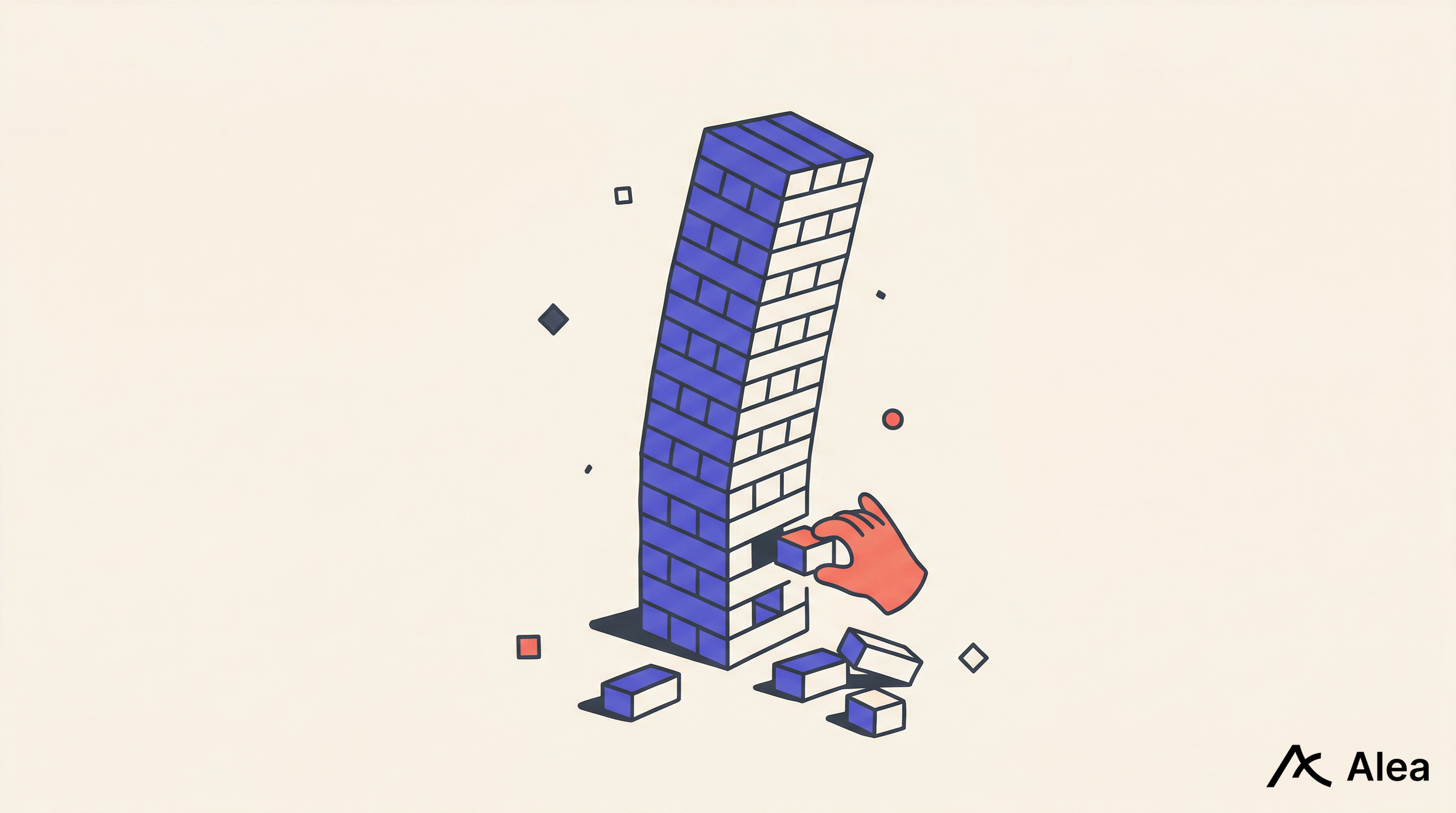
Code has become cheap. Software is abundant now. AI can move at a pace no human team can match. But can AI really understand? Can AI really understand the way you do things the way you want them, or how you deal with the weird edge cases that only show up under real use?
Yes, AI is often better, faster, cheaper, and safer than humans, especially on narrow tasks, but what happens in a complex system? Software, for example, doesn't just get a bit harder as it grows. Interactions multiply and the number of possible states grows faster than linearly, exponentially in most cases. AI does indeed lower the cost of producing code, which means it also lowers the cost and time of producing a mess.
Use agents on the speculative side of the barbell. Let them draft internal tools, one-off scripts, test scaffolding, migration plans, benchmark experiments, and ugly chores you can verify quickly. Let them propose 5 approaches to a bounded problem. Let them search, summarize, and prototype. That gives you cheap optionality: lots of tries, small downside, occasional big upside. Take advantage of those scoped tasks where the agent can evaluate its own work and a human stays as the final quality gate.
The seductive story around AI coding treats production as the constraint. In practice, comprehension has been the harder limit. AI is just way too fast. It produces so much code. Humans cannot keep up.
In the past, humans were slow enough to notice when a pattern felt wrong. Some of that friction was waste. Some of it, however, was the mechanism by which taste formed. Remove all of it, and the result is delayed pain.
The winning posture is almost boring. Prolific programmers have always looked slower at close range. They spend longer naming things. They delete more than they add. They keep modules small. They stop before the extra layer. They write code other people can change without fear. They, like masters in any other fields, are big proponents of the philosophy that "less is more."
We live in a culture that rewards visible output. More posts, more meetings, more features, more automations, more words, more motion. AI only turns the dial higher. It makes production cheaper in almost every direction. You can generate faster, publish faster, respond faster, build faster.
Across fields, AI creates a new risk, and the pattern is the same. Each addition looks harmless on its own. Then the interactions pile up. What used to feel flexible starts to feel brittle. What looked like speed turns into debt.
That's true in software, of course. But it's also true in companies, calendars, strategies, products, media diets, and lives.
You can feel it in organizations that can't make a clean decision because they've accumulated too many priorities. You can feel it in products that used to be elegant and now feel swollen. You can feel it in people who are drowning in commitments they said yes to one at a time.
The best eventually learn a hard rule: every addition is a future obligation. That's why greatness often feels effortless. The best people become subtractors. Not because they lack ambition. Because they understand complexity.
Great writers cut. Great designers remove. Great investors wait. Great operators narrow the plan. What looks like ease on the surface usually comes from ruthless selection underneath.
That's why "less is more" keeps surviving as advice, even after it's been flattened into cliché. Fewer moving parts often means more clarity. Fewer commitments often means more focus. Fewer features often means a better product. Fewer words often means more force.
Slowing down can feel like falling behind. Doing less can feel lazy when everyone around you is accelerating. Saying no can feel irresponsible when the world rewards visible busyness. A packed schedule looks serious. Constant shipping looks impressive. A flood of output looks like momentum.
Restraint has a public relations problem.
Its benefits are often invisible at first. The meeting you didn't schedule doesn't show up on a dashboard. The feature you killed can't be demoed. The complication you avoided doesn't get celebrated. The white space in your day can even make you look less committed than the person sprinting into the next avoidable mess.
That's why so many smart people overproduce. They're not confused about quality. They're scared of irrelevance.
And to be fair, the fear isn't irrational. Markets move. Competitors ship. Tools improve. People who hesitate for too long do get passed. Some speed is necessary. Some experimentation is healthy. Some overbuilding is how you learn.
But there's a difference between moving fast and multiplying fragility.
The best people know where speed helps and where it poisons the work. They use leverage on the cheap, reversible parts. They stay careful on the decisions that shape everything downstream. They let tools accelerate the draft, not define the standard. They protect the core and experiment at the edges.
Less raises the standard.
Maybe that's the clearest way to say it: greatness looks effortless because someone paid for simplicity with discipline.
They resisted the extra step. They declined the extra feature. They sat with the problem long enough to see the shape of it. They left friction where friction teaches and removed friction where it merely distracts. They understood that more inputs, more complexity, and more activity don't always create more value. Sometimes they just create more to carry.
That's the uncomfortable truth of this moment.
As tools make output abundant, restraint becomes rarer. And rarer is usually where the edge goes.
The people who win won't be the ones who can do the most things at once. They'll be the ones who know what to ignore, what to remove, what to protect, and when to stop.