

Flashy Demo, Weak Business
March 28, 2026
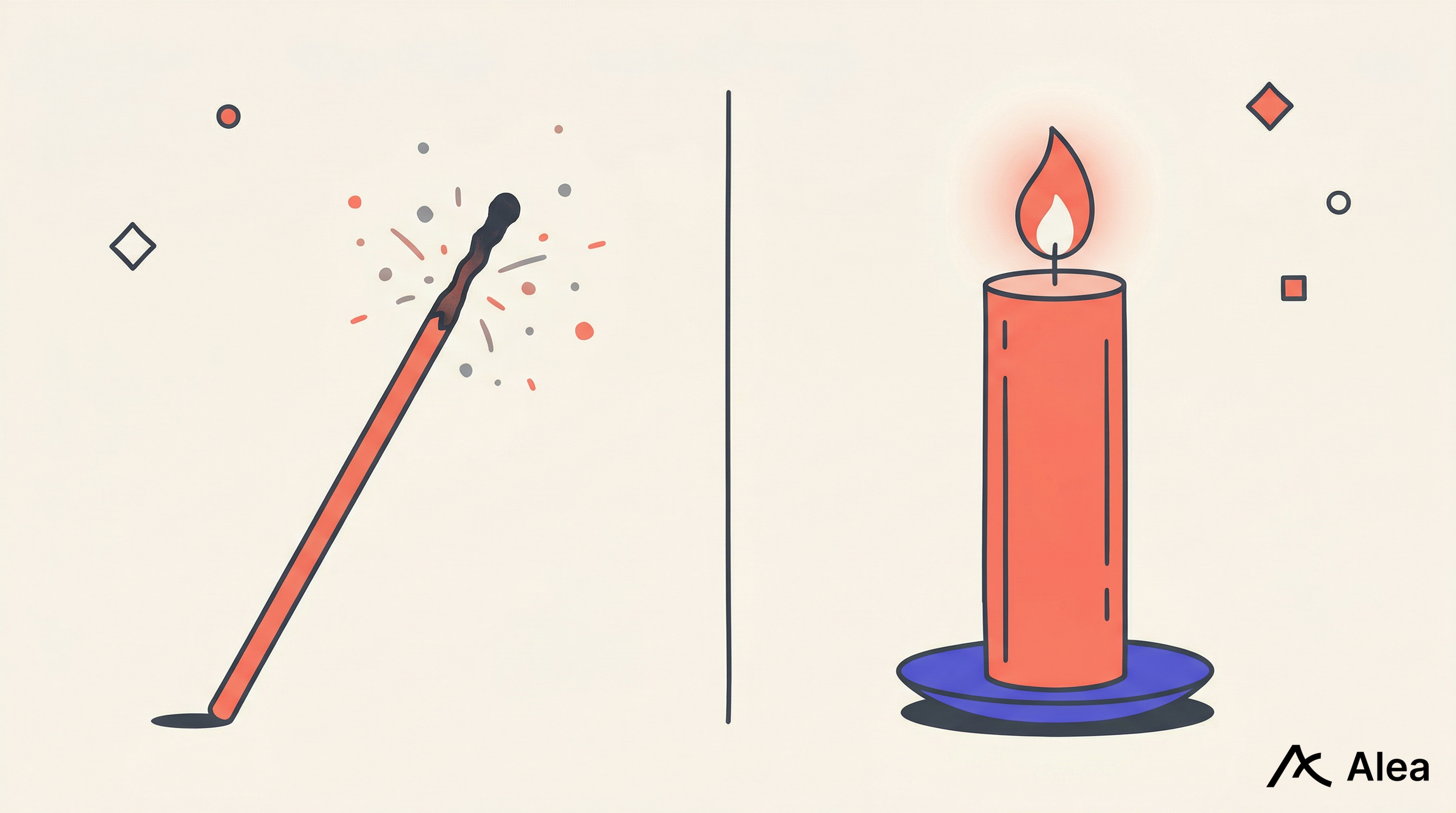
Most AI product bets hide the same assumption: make creation easy enough and everyone will become a creator.
It sounds right in a demo. It breaks in real life.
People love trying a new creative tool. It reminds them of the personal satisfaction that is felt when they are in a state of flow. However, unlike truly creative endeavors, like the act of writing or coding, creating through AI tools feels fundamentally different.
The results speak for themselves, as evidenced by OpenAI scrapping Sora. Users would make 2 or 3 absurd clips, share them in group chats, post on social media, and feel the jolt of magic. Then the feeling passes, and the habit never really forms.
Such is how novelty works. A burst of curiosity can look like demand. Often it is just the prelude to hedonic adaptation.
Most people are not failed filmmakers, designers, musicians, or game makers waiting for the right interface. They are consumers with occasional creative impulses. They like the idea of making things more than the practice of making them. You can generate sequels for your favorite books or movies anytime you want these days, but have you really done that? Do you really feel tempted to do that?
The old internet rule applies. A small minority creates. Everyone else watches, listens, reads, and scrolls. Better tools can widen the top of the funnel, but they do not erase that asymmetry. Lowering the cost of creation does not create the will to create.
It mostly helps people who already had intent. Professionals. Semi-pros. Obsessives. Hobbyists who were always going to spend Saturday afternoon editing, animating, sketching, or prompting until the result clicked. For them, AI is not a party trick. It is leverage.
Everyone else behaves differently. They do not want an infinite blank canvas. They want an outcome. A finished ad. A tighter edit. A better deck. A joke for the group chat. A quicker answer. The moment a product asks them to behave like a creator every day, the market shrinks fast.
This is where a lot of AI product thinking goes wrong. Builders see a new model capability and infer mass demand. If anyone can make a video, everyone will want to. If anyone can generate an app, everyone will become a builder. If anyone can design a logo, everyone will open a brand studio.
Usually the opposite happens. A thin slice of users goes deep. Everyone else samples the magic and leaves.
That does not mean creative AI is a dead end. It means the durable businesses will look narrower, and probably less glamorous, than the early hype suggested.
One category will sell leverage to people who already create for a living. These users do not need inspiration. They need speed, control, consistency, and lower costs. They are buying margin.
Another will build audience businesses on top of AI output. If most people do not want to make 50 things, they may still want to watch 500 things made by someone else. That points toward feeds, franchises, characters, and creator ecosystems, not just standalone generation tools.
The third will hide the model inside existing work. Most users do not wake up wanting to generate. They wake up wanting to finish. Send the campaign. Cut the reel. Summarize the meeting. Handle the support queue. Ship the product. In those cases, AI wins because it disappears into the job.
The best AI product question is not "What becomes possible?" It is "What becomes habitual?"
That is the filter a lot of the market still resists. Spectacle gets headlines. Habit gets retention. Monetization follows one of the two, but not by accident. If a product is expensive to serve and weakly tied to either daily workflow or mass audience attention, even a brilliant demo can turn into a bad business.
Founders and investors should press on 4 questions earlier than they do. Who comes back next week? Who already pays for the outcome? Is the user trying to create, consume, or complete a task? And does the cost curve improve faster than the novelty curve decays?
Those questions sound less exciting than the demo reel. They are also closer to the truth.
AI will keep making creation easier. That part is real. But easier creation does not mean universal creation. The enduring companies will be the ones that respect the old asymmetry instead of pretending it has vanished. They will help professionals make more, help audiences consume more, or disappear inside work people already need done.
Everything else risks becoming a very impressive 2-week obsession.