

Frictionless Creativity
March 26, 2026
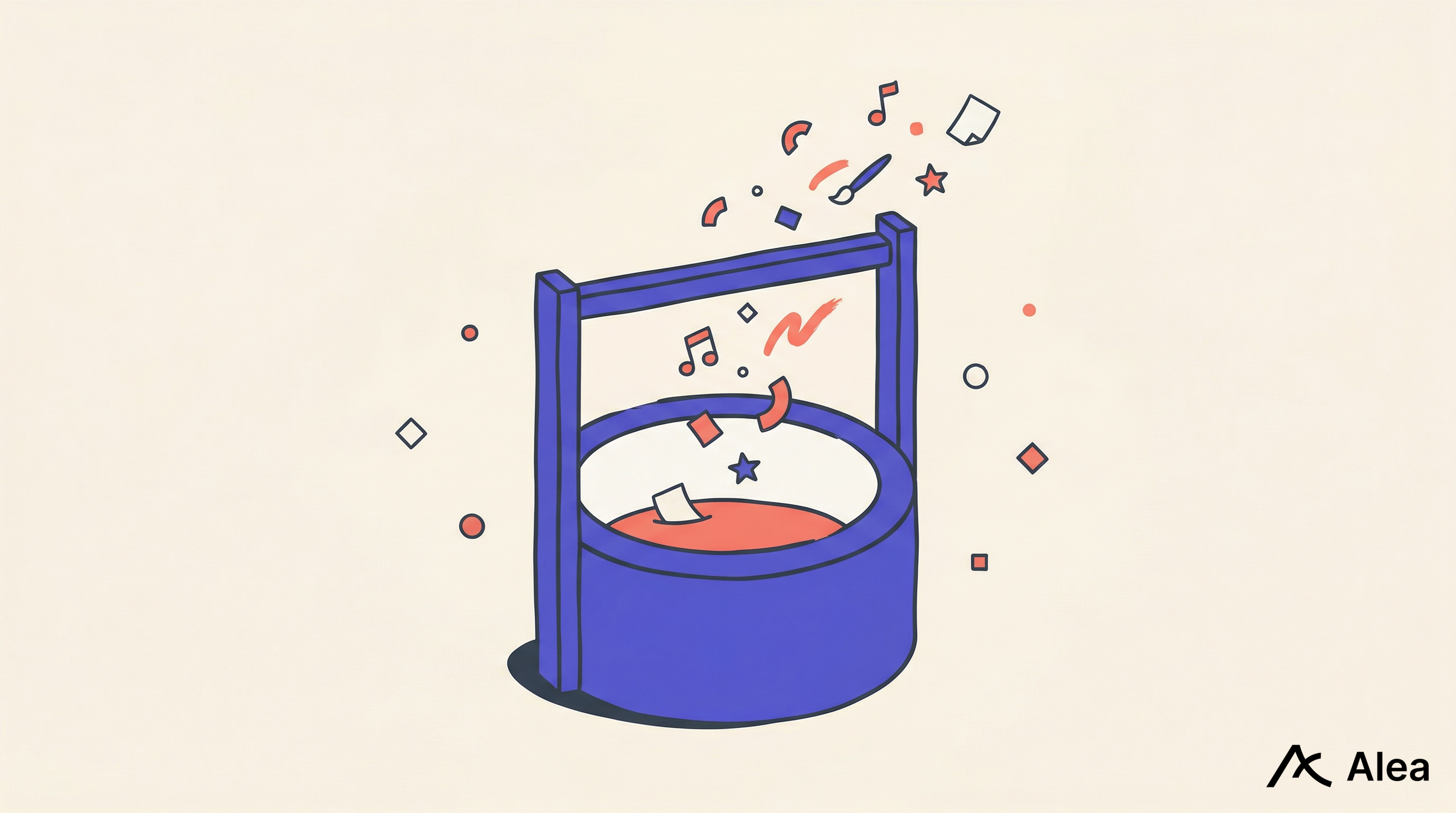
AI Can Drain The Well Faster Than Life Can Refill It
AI compresses months of creative output into days. It doesn't just speed up creation. It lets you spend your accumulated creative energy faster than life can replenish it. Sustainable advantage now depends on managing novelty, friction, and the offline inputs that refill judgment.
With Suno, a single person can turn a backlog of half-finished musical ideas into dozens of tracks over a weekend. With language models, you can spin up interactive fiction, roleplay, story branches, product concepts, and endless variants of the same idea before lunch. With agents and good coding tools, the time between "I should build this" and "I built a version of it" keeps collapsing.
The gain is real. The tradeoff is real too. When execution gets cheap, the scarce input becomes whatever the machine cannot supply on demand: lived experience, taste, judgment, and surprise.
The new bottleneck is the human well behind the work.
For most of modern creative life, friction acted like a hidden governor. Learning the instrument took time. Recording was awkward. Coordination slowed everything down. Shipping software meant fighting the stack. Even talented people could only get ideas out at a certain pace.
That friction was frustrating. It also did useful work. It spaced output. It forced selection. It gave ideas time to ferment.
AI strips a lot of that away. It compresses logistics, coordination, and craft into a prompt, a click, or a guided workflow. Years of pent-up references, obsessions, and half-built projects can come pouring out in a few intense weeks.
Then a different wall appears.
People reach for the word burnout. Sometimes that's right. But there's a more specific failure mode here. AI lets you empty the well faster than life can refill it. You cash out your backlog of novelty at machine speed. Then the tool still looks limitless while you feel abruptly finite.
Rest helps. Refill matters more.
Refill comes from high-entropy input, meaning signals you didn't already predict. Another person's structure. A conversation that changes your angle. A boring afternoon. A book you wouldn't have picked. A place that doesn't fit your routines. Time long enough for an idea to mutate before you turn it into a file.
That helps explain why hyper-personalized AI content loses its charm so fast. A custom story tuned to your exact preferences sounds ideal. A game that bends around your taste sounds even better. A music model that gives you endless tracks in your favorite style feels magical for about 5 minutes.
Then the surprise drains out.
Culture works partly because it exposes you to another mind. Someone else chose the pacing, the cut, the wrong turn, the reference you would not have made. Fully steerable AI content can erase that otherness. You get more of what you already like, in forms you already recognize, at a volume no human could sustain. Supply rises. Discovery shrinks.
Models worsen this because they tend to smooth toward familiar patterns. Keep sampling and you start to hear the average. The 1st result can feel uncanny. The 30th often feels like a slightly flatter version of your own taste. People who are especially sensitive to patterns often hit that wall first, because they learn the model's habits sooner.
Rare surprise matters more than infinite content.
Many AI products are still misreading this curve. They assume more generation means more value: more images, more songs, more scenes, more agent actions, more personalized feed. But novelty in these systems doesn't decay gently. It often drops fast once users learn the system's moves.
That matters for builders. The strongest products will manage pacing, curation, and surprise. They'll know when to narrow choices, when to filter hard, when to hold something back, and when to inject a genuinely external signal. Product teams should borrow from editors, teachers, DJs, and game designers alongside search and autocomplete.
The same logic applies at work. Early AI adoption often looks like euphoria. Then it turns into sprawl. Then usage settles into a smaller set of tasks people actually trust and can sustain. Reliability is part of that story. Saturation is another part. When every blank page is instantly fillable, every task becomes expandable. The day stops ending on its own.
That can feel worse than old friction because it turns the shortfall inward. If the tool is always available, always fast, always ready to help you do more, the gap between possible output and human energy starts to look like a personal failure. Pair that with hustle culture and work-maximization habits, and recoil becomes predictable.
The practical move is to design better constraints.
Treat refill as part of the workflow. The inputs that matter most may now be the least legible to software: conversation, boredom, collaboration, time away, a medium you're bad at, a week where nothing ships. Put limits on branching. Add waiting periods before review. Stop after a small number of generations and choose. Spend time on inputs that aren't already shaped around your profile. Protect the parts of life that feed taste instead of just extracting it.
The durable edge in AI comes from protecting the conditions that make good work possible in the first place.
AI will keep removing friction. That's real progress. Once the old bottlenecks disappear, people and products need new discipline. Real life, other people's taste, and a bit of resistance keep the well from running dry.