

The OpenClaw Craze in China
March 19, 2026
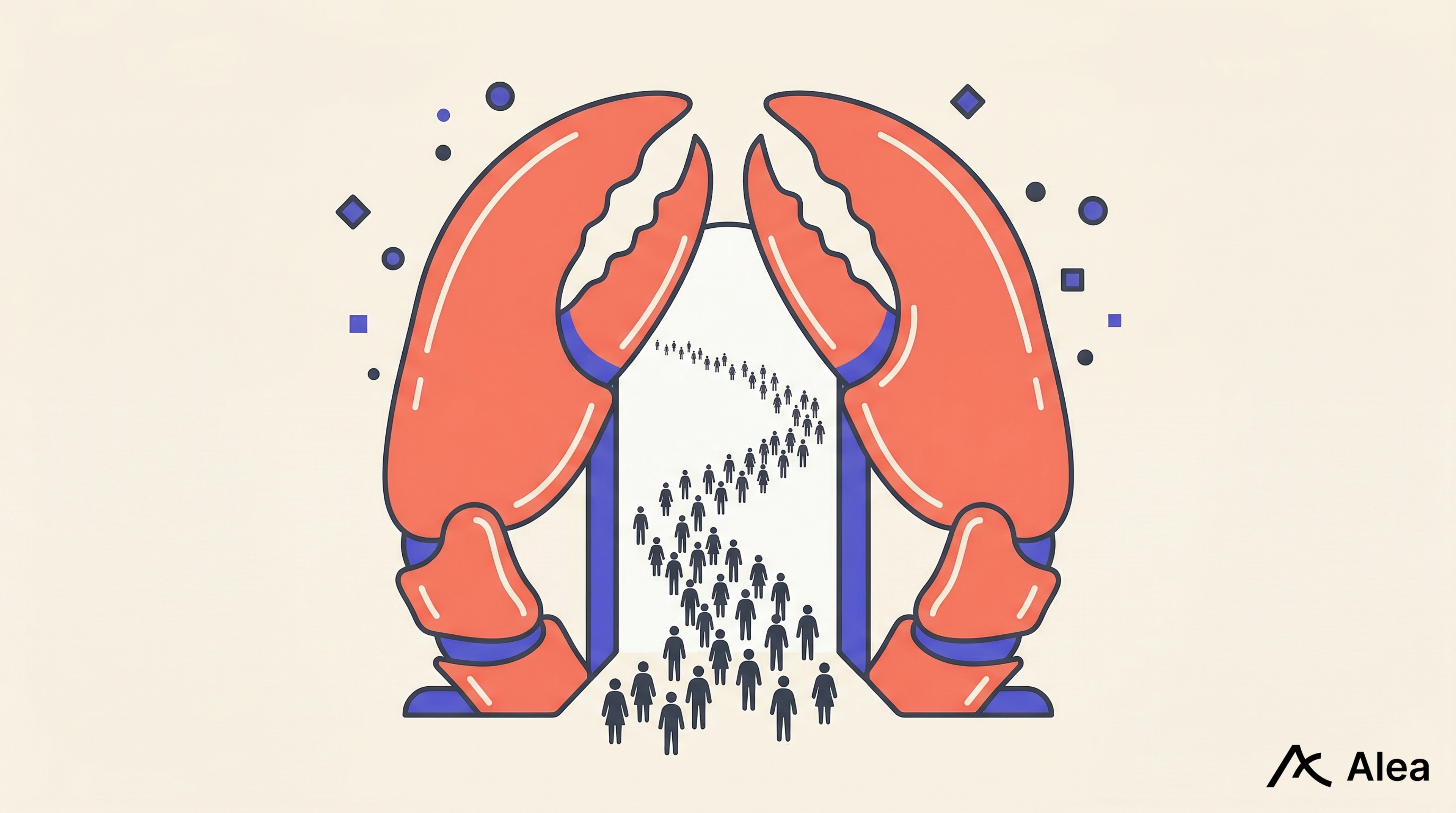
An open-source AI agent built by Peter Steinberger (@steipete) became the most-starred GitHub project in history, hitting 320,000 stars in under 100 days. The place it unexpectedly exploded hardest was China, where it turned into a meme, a government policy object, and the foundation of a new entrepreneurship narrative.
TL;DR
- OpenClaw hit 320,000 GitHub stars in under 100 days, with roughly half its agents running in China
- Chinese users run it on domestic models (MiniMax, Kimi, DeepSeek) at 17x lower cost than Claude
- Cities subsidize OpenClaw deployment while state enterprises are banned from installing it
- Every major Chinese cloud provider launched its own clone, all defaulting to Chinese models
OpenClaw, briefly
OpenClaw is an AI agent framework. Where a chatbot answers questions, OpenClaw carries out tasks: clearing inboxes, sending emails, managing calendars, running scripts, browsing the web. It sits inside messaging apps people already use (WhatsApp, Telegram, Slack, Feishu) and works in the background with persistent memory. An AI assistant that acts, not one that waits to be asked.
Peter Steinberger released it as open source in late 2025. By early 2026, it had become the most-starred project on GitHub, surpassing Linux's all-time count in weeks. Steinberger joined OpenAI on February 14; the project moved to an independent foundation.
Then China happened.
On March 6, roughly 1,000 people showed up at Tencent's Shenzhen headquarters for free installation help. Not just developers. Zeyi Yang of MIT Technology Review reported grandparents and children in the crowd.
The nickname "raise a lobster" (养龙虾) comes from OpenClaw's red lobster logo. It spread across Xiaohongshu, Douyin, and Bilibili, turning a software install into a social event. Installation services appeared on secondhand marketplace Xianyu, charging 100 to 1,500 yuan ($14 to $218). Some providers earned 260,000 yuan within days.
Chinese tech firms moved faster than the meme. All five major cloud providers launched one-click deployments or built their own versions within weeks. ByteDance built ArkClaw (defaulting to its Doubao model). Baidu launched DuClaw, which requires no API key, no server, no configuration: open a browser, start using it. Tencent released QClaw with WeChat and QQ integration. Moonshot AI shipped KimiClaw, MiniMax shipped MaxClaw, Zhipu AI shipped AutoClaw with 50+ pre-installed skills. Alibaba, Huawei, and Xiaomi followed with their own variants.
By March 2026, roughly 142,000 publicly visible OpenClaw agents had been tracked globally. Nearly half of them were running in China.
Why China, and why this fast
OpenClaw landed at the intersection of five forces that were already building.
It feels like action, not chat. Chinese coverage consistently frames OpenClaw as a step beyond chatbots. Jiang Han, a senior researcher at Beijing's Pangoal think tank, called it "a key leap in AI from simply responding to questions to planning and executing tasks." That framing made it an easier sell than another language model.
It fits the "one-person company" narrative. Reuters reported that the tool became tied to the idea that one person, powered by agents, can do the work of several. Shenzhen's Longgang district drafted official measures explicitly built around "OpenClaw & OPC (One Person Company)." Shenzhen's health system trained 200 staffers onsite (4,000 more online) and framed OpenClaw as a "digital employee." The phrase "智能经济" (intelligent economy) appeared across Chinese coverage, positioning agents as infrastructure rather than novelty.
Local governments tried to industrialize the trend. China's 2026 government work report calls for promoting intelligent agents, supporting open-source AI communities, and building the "intelligent economy." Cities competed to act first. Wuxi published "12 measures for raising crayfish," subsidizing deployment, compute, and data. Longgang offered grants up to 10 million yuan ($1.4 million). Several hubs packaged free compute, office space, and accommodation for OpenClaw startups.
It became a scene. Baidu engineers set up an outdoor "Lobster Market" that drew 1,000 visitors and launched DuClaw on the spot. Shanghai and Shenzhen hosted bootcamps. "Little Lobster Birth Certificate" memes circulated on Xiaohongshu. Tutorial videos flooded Douyin and Bilibili promising AI mastery in minutes. The meme layer turned agentic AI into a social activity, not a technical adoption curve.
Tech firms wrapped it for mainstream users. One-click deployment from every major cloud provider made OpenClaw feel less like a foreign GitHub project and more like something already inside the domestic stack. Alibaba Cloud offered deployment for 9.9 yuan ($1.40). ArkClaw launched with a 7-day free trial. Tencent promised setup in under 3 minutes. The market responded: Tencent's stock rose 8.9% in a single week. MiniMax jumped 27.4%, with shares up 600% from its early-2026 IPO.
What gets installed, and what runs it
When someone lined up at Tencent's headquarters or paid 500 yuan for an on-site setup, what they got was OpenClaw itself, the open-source version running on their own laptop. The clones (DuClaw, ArkClaw, QClaw) are separate cloud-hosted products that launched in parallel as easier alternatives.
Setting up OpenClaw requires choosing a model provider and entering an API key. The software's onboarding wizard suggests Claude Sonnet. Its documentation defaults to Claude Opus. If an Anthropic API key is present, Claude takes first priority.
In China, almost nobody takes that default.
Chinese users connect to domestic model providers: MiniMax, Moonshot AI (Kimi), DeepSeek, Zhipu AI (GLM), or Alibaba's Qwen. Some use the AIsa gateway, a single API key that routes to multiple Chinese models. A common setup recommendation in Chinese communities: "Use Qwen for Chinese-language tasks, DeepSeek for coding." The API key links to the provider's account, where users top up credits as they go, much like a prepaid phone plan.
The target users tell the story too. Sixth Tone reported that installation services focused on e-commerce merchants automating product listings, media teams managing content pipelines, and financial analysts processing data. These are people who saw OpenClaw not as a toy but as a way to do more with less headcount.
The economics explain the choice. OpenClaw burns tokens fast. A single active session can exceed 200,000 tokens. Power users consume 50 million tokens per day. At Claude Opus pricing ($5 per million input tokens), that costs $250 a day. At MiniMax M2.5 pricing ($0.30 per million), the same usage costs $15. One Shenzhen programmer spent 12,000 yuan ($1,660) in three days from a misconfigured agent.
MiniMax M2.5 scores 80.2% on software engineering benchmarks. Claude Opus scores 80.8%. Nearly identical quality, 17x lower price. By February 2026, Chinese models accounted for 61% of all token consumption on OpenRouter, the largest model marketplace. Four of the top five models by volume were Chinese.
The cloud-hosted clones reinforce the same pattern. ArkClaw defaults to ByteDance's Doubao. Alibaba Cloud defaults to Qwen. DuClaw offers DeepSeek, Kimi, GLM, and MiniMax but not Claude or GPT. No Chinese clone supports Western models. The framework is Western. The brain running inside it is Chinese.
Promotion plus containment
The same government promoting OpenClaw is also clamping down on it.
On the promotion side: China's 2026 government work report explicitly calls for promoting intelligent agents, supporting open-source AI communities, and scaling commercial applications under the "intelligent economy" banner. Cities competed to move first. Longgang (Shenzhen) drafted official measures to build an "OpenClaw & OPC ecosystem," with a public comment period running through April 6. Wuxi published "12 measures for raising crayfish," subsidizing deployment, compute, data, and tooling. Several hubs offered free compute, accommodation, and office space for OpenClaw startups. Shenzhen's health commission ran a citywide training: 200 attendees onsite, 4,000 watching online.
On the containment side: Beijing warned state agencies and state-owned enterprises not to install OpenClaw on work devices. The NVDB (Network Security Threat and Vulnerability Information Sharing Platform) published "six do's and six don'ts" for safe use. The National Internet Finance Association issued the country's first sector-specific warning, telling financial institutions to keep OpenClaw off devices that handle customer data, fund transfers, or trading. Researchers found 341 malicious skills on ClawHub, 335 of which installed Atomic Stealer malware on macOS. Multiple CVEs were published covering remote code execution, command injection, and authentication bypass.
The tension makes sense when you consider what OpenClaw actually does. A chatbot generates text. OpenClaw reads files, executes shell commands, controls browsers, and sends messages on your behalf. That is a different risk profile. An agent with those permissions on a government laptop or a bank terminal is a security problem that "six do's and six don'ts" cannot fully solve.
Even OpenClaw's own team acknowledges prompt injection remains unsolved. They added VirusTotal scanning for skills, but the attack surface is structural, not incidental.
South China Morning Post captured the whiplash in a single headline: users who paid to install OpenClaw were now paying to have it removed. The cycle from enthusiasm to anxiety took less than two weeks in some cases. Bloomberg called it "a massive, risky AI experiment" being run at national scale before safety rules exist.
OpenClaw found something in China that no amount of GitHub stars could manufacture: a system ready to absorb it. Meme culture that could spread it, industrial policy that could fund it, domestic models that could power it cheaply, and a regulatory apparatus still figuring out where the guardrails go.
Explore the tool yourself → openclaw.ai