

Pulling the Prompt Lever
March 19, 2026
OpenClaw is a good case study that people don't know what they want. That's because it shows what many people are actually buying or building in AI: not a well-defined solution, but an easy action that feels like progress.
Earlier this month, people queued for help installing OpenClaw. Later, they were paying to have it removed. The product itself promises a personal AI assistant that clears your inbox, sends emails, manages your calendar, and checks you in for flights through the chat apps you already use. That is a powerful pitch when the real need is still blurry. What do you want, really?
The hype spread fast. Many rushed to launch their own OpenClaw installers so others could easily access their "lobsters," in a few clicks. Many called the boom a gold rush, comparable to the launch of GPT or Claude Code, with people renting cloud servers and buying AI subscriptions just to try it.
The speed of adoption matters because fast adoption often tells you less about clear demand than about how attractive the next easy move has become. From the outside looking in, adoption felt compulsive rather than genuine.
Indeed, most people are poor judges of their own latent demand. They feel the pain accurately. They specify the solution badly. Do you need a personal assistant, really?
Latent demand is what a user would choose if they could see the full trade-off upfront: time, cost, maintenance, error rate, cleanup, and whether the thing still helps 30 days later. Most people can't see that far. So they reach for the easy adjacent action.
That is the pattern.
When the job is unclear, easy action wins. Download the tool. Generate the mockup. Ask for the dashboard. Spin up the agent. Pull the prompt lever. Each move produces something visible. The harder work stays untouched: define the problem, decide what good looks like, cut the bad options, and sit with the blank page long enough to produce something worth keeping.
The Seduction of Easy Things
- Build a dashboard to postpone a decision.
- Spin up an agent to dodge 1 repetitive task.
- Generate 20 ideas to avoid choosing 1.
- Create a content engine to postpone the paragraph that matters.
- Build a second brain to avoid remembering 5 important things.
- Ask for a research copilot to avoid sharpening the question.
- Automate meetings to avoid naming an owner.
- Ship a no-code app to avoid committing to a workflow.
- Start an AI company to avoid talking to a customer.
- Keep prompting to avoid thinking.
AI makes this temptation much stronger.
Before generative AI, bad ideas had more friction. They took time, money, or embarrassment. That friction acted like a brake. Now the wrong move can show up as code, copy, slides, product plans, or a prototype in seconds. The artifact arrives before the judgment.
For a nontechnical user, a screen full of code looks like competence. For the person who has to own that code a month later, it may be the first draft of a headache.
That gap matters more than most people think. Code is visible. Architecture is not. A working demo is visible. Maintenance is not. A generated article is visible. Taste is not. A prompt library is visible. Clear thinking is not.
Prompting Is the New Procrastination
There is now some evidence for the cognitive side of this. A 2025 Microsoft-led survey of 319 knowledge workers found that higher confidence in generative AI was associated with less critical thinking, while higher self-confidence was associated with more. The same study found that AI often shifts the user's role from producing an answer to verifying, integrating, and stewarding it. (Microsoft)
The dependence story needs more care. A 2025 paper in Addictive Behaviors argued that the evidence for "ChatGPT addiction" is still too weak for a clinical label. That caution matters. At the same time, other researchers are finding reasons to worry about the interaction pattern itself. Microsoft's synthesis of roughly 50 papers says overreliance can hurt human and AI team performance and can even end in product abandonment. A CHI 2025 paper examined addictive design patterns in chatbot interfaces. A 2026 preprint analyzing 334 Reddit accounts tied problematic use to an "AI Genie" effect: users get what they want with very little effort. (ScienceDirect)
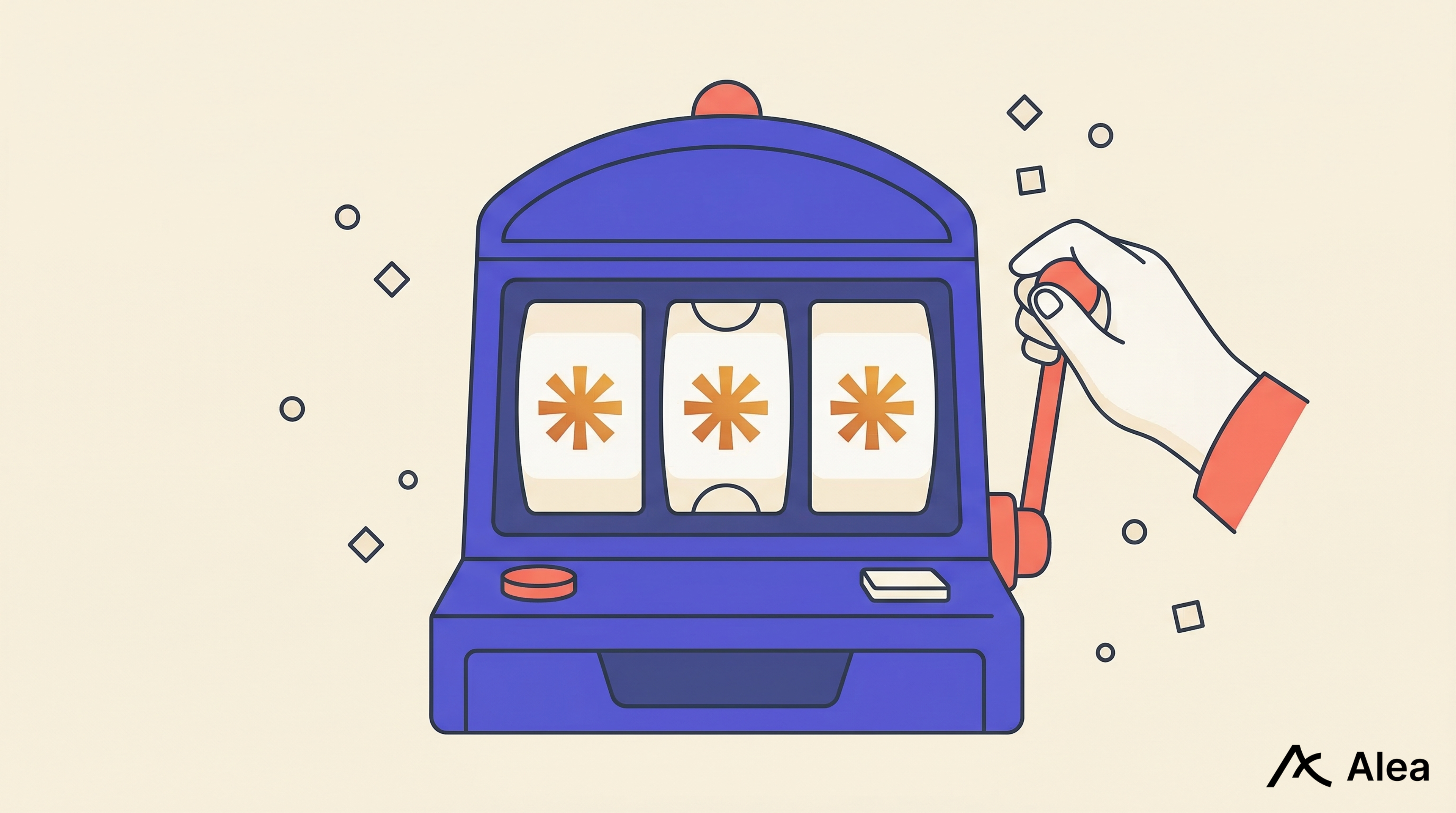
That is the useful frame. The strongest claim is not clinical addiction. The stronger claim is that the interaction has a slot-machine rhythm. The cost of another prompt is close to zero. The response is immediate. The reward is variable. Sometimes you get sludge. Sometimes you get something uncanny. That variability invites another pull. The loop is cheap, fast, and hard to leave. (ACM Digital Library)
This is where AI starts to behave like a vampire. It promises to save attention, then feeds on it. More prompts create more branches, more cleanup, more selection, and more reasons to prompt again. The user feels productive because the system keeps producing artifacts. Quantity rises. The hard part stays put.
The hard part has always been judgment.
Judgment decides what problem is worth solving. Judgment knows when the draft is generic. Judgment sees that the app should not exist. Judgment cuts 90 percent of the output and keeps the 1 page, feature, or workflow that matters.
AI lowers the cost of producing options. It leaves judgment scarce.
OpenClaw and the Illusion of Progress
OpenClaw caught on because it made agency feel tangible, social, and easy. The software spread alongside a culture of lobster hats, claw-hand poses, meetups, and the language of "raising lobsters." Business Insider reported that the social layer itself helped drive adoption, with users drawn by belonging and social learning as much as by technical understanding. That is how vague demand often moves through a market. People copy each other long before they can evaluate the thing in front of them.
Many users probably did have real jobs they wanted done. Email triage. Scheduling. Small admin chores. Repetitive research. The mistake came later, when the tool became the job. That happens all the time in AI. The app replaces the outcome. The workflow replaces the decision. The prompt replaces the thought.
More is not better. More code is not a better product. More drafts are not better writing. More automation is not better judgment. More activity is often a way to avoid the hard thing that would actually move the work forward.
The next good AI products will understand this weakness and design around it. They will narrow the job, reduce the number of choices, hide unnecessary power, and make quality easier to spot. They will help users do fewer things, better.
The scarce skill is still judgment. The scarce product is the one that helps people stop pulling the lever and start doing the hard thing they were avoiding.