

Demo Theater, Layoff Fantasy
March 23, 2026
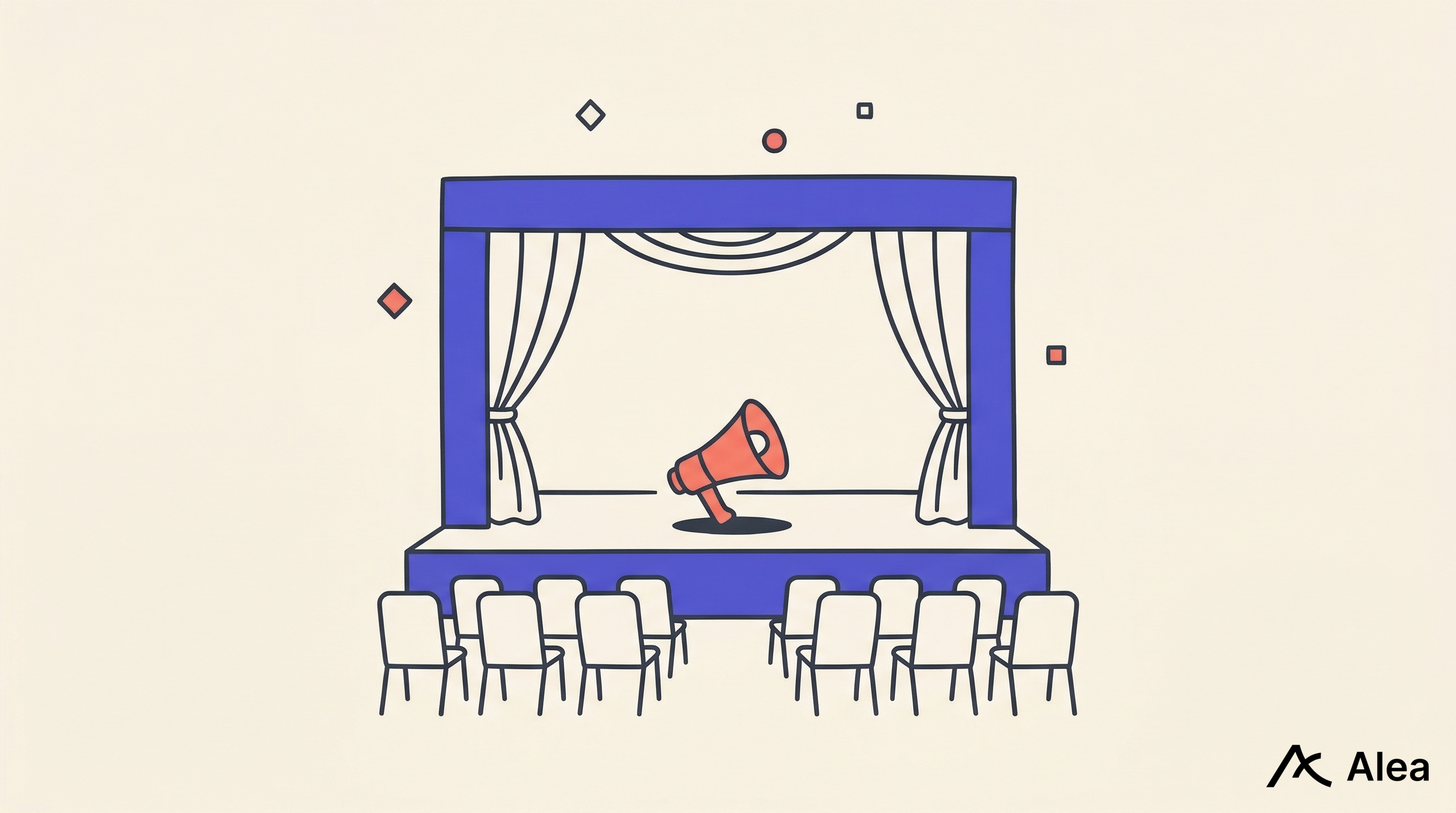
Most AI job panic starts the same way: a tool does 1 visible thing well, and someone jumps from "that task got cheaper" to "that profession is finished."
You can watch the whole cycle happen in an hour.
A clip goes up. An AI agent fills out a form, drafts a memo, cleans a spreadsheet, books a flight, or summarizes a meeting. The replies arrive on cue.
- "There goes ops."
- "Analysts are cooked."
- "Junior lawyers won't exist."
- "PMs are just overhead now."
By dinner, people whose jobs pass through a laptop feel like they've been turned into a rounding error.
Fear moves fast; the labor market moves slowly. A scary caption can change someone's mood in 18 seconds; a company can take 18 months to change a workflow.
This piece is about the social mechanics of panic: the fallacies, the rhetorical moves, the personality tells, and the habits that help you keep your balance when the takes get theatrical.
The First Move: Shrink The Job
This is the oldest trick in the set.
Take the most legible part of a job, show that AI can do some version of it, then pretend that visible part was the whole thing.
- "It wrote the memo. Strategy is done."
- "It made the deck. Associates are done."
- "It answered the email. Support is done."
- "It wrote the code. Engineers are done."
That logic works only if you believe the job was the artifact.
It usually isn't.
A strategy memo is not strategy. The memo is the trace strategy leaves behind. The actual job includes deciding what question matters, choosing what evidence counts, spotting what's missing, reading the politics, making the tradeoff, and standing behind the answer when someone senior pushes back.
Same with coding. Same with legal work. Same with research. Same with marketing. Same with recruiting.
A good model can often imitate the residue of work before it can carry the burden of the work.
That's why these claims land so hard on knowledge workers. The visible part of their labor shows up as text, slides, dashboards, comments, tickets, and calls. AI is good at visible parts. People then confuse legibility with totality.
A Fallacy Is A Bad Argument With Good Lighting
Most AI doom rhetoric relies on a handful of bad arguments that sound sharp when delivered quickly.
Composition Fallacy
1 task gets cheaper, so the whole role gets declared obsolete.
A model drafts a passable market summary. Someone says research is dead. But the summary didn't decide where to look, what to trust, what to ignore, or what the finding means for an actual decision.
Demo-To-Deployment Leap
A performance demo gets treated like a stable work system.
A founder shows an agent updating a CRM, sending follow-ups, and logging notes. Great. Now run that through a real company with bad data, partial permissions, weird customers, conflicting priorities, missing fields, and compliance review.
False Precision
A guess gets dressed up with a date and a body count.
- "Half of white-collar jobs gone by 2028."
- "Junior analysts replaced in 24 months."
- "3 years left for recruiters."
Exact dates make vague claims feel scientific. A calendar is doing a lot of the persuasive work there.
Base-Rate Neglect
People forget how slow firms are.
Large companies do not change because a demo went viral. They change when the software works, the risk team signs off, the managers trust it, the process gets rewritten, and someone owns the mistakes.
Category Error
Typing words gets confused with making judgments.
A model can draft. That does not mean it can own. Those are different categories.
The Second Move: Turn Possibility Into Fate
A lot of AI rhetoric starts as "this might happen" and ends as "this will happen."
"Could automate" becomes "will automate." "Can perform" becomes "can replace." "Might reduce headcount in some workflows" becomes "most people are finished."
Some of that comes from ordinary sloppiness. Some of it comes from incentives. A CEO wants to sound ahead of the curve. A founder wants to sound inevitable. A media outlet wants a clean headline. A commentator wants status for sounding unsentimental.
The Third Move: Make Fear Sound Intelligent
There is real status in being the darkest person in the room.
Say the calm thing and you risk sounding naïve. Say the most severe thing and you sound serious, plugged in, unfooled. You sound like someone who sees the hard truth.
That social reward matters more than people admit.
You can hear it in the tone:
- "Anyone paying attention knows where this ends."
- "If you're not worried, you don't get it."
- "This is obvious now."
- "The people laughing are coping."
Panic gets framed as realism. Measured judgment gets framed as denial.
That is a psychological trick as much as an intellectual one. It pressures you to borrow someone else's emotional register just to prove you are not behind.
You do not need to sound alarmed to be clear-eyed.
The Fourth Move: Go After Identity
This is the part that makes the whole thing feel personal.
A lot of rhetoric around AI and work is quietly humiliating. It does not just say a task is automatable. It tells people their craft was fake, their contribution was thin, and their career was basically a UI wrapper waiting to be deleted.
You hear versions of it all the time.
- "You were never doing real work."
- "You just moved words around."
- "A good model is already better than most office workers."
- "If your job happens on a screen, you're in trouble."
That hits because it targets dignity, not just forecasting.
People don't just hear, "A tool got better." They hear, "You were never that useful." That is why the conversation can feel weirdly moralized. It is not only about labor demand. It is about status, self-respect, and whether your competence still counts.
Your value was never the keyboard. The keyboard is where part of your value leaves a trace.
The Personality Tells
Certain characters show up again and again in AI job panic. Once you spot the type, the script gets easier to read.
The Countdown Guy
Always has a date. Loves "within 2 years" or "by 2030."
The date is the product. It creates urgency, even when the reasoning underneath is thin.
The Demo Collector
Lives off clips. Treats 3 successful runs as proof of industrial replacement.
Never wants to talk about edge cases, failure rates, or handoffs.
The Margin Romantic
Turns every productivity gain into a layoff fantasy.
If a tool saves 20 minutes, this person jumps straight to "cut the team in half." That skips right past demand growth, faster iteration, quality gains, and the stubborn fact that firms often use efficiency to do more, not only to employ less.
The Status Doomer
Wears dread like a tailored jacket.
Calm people annoy this person because calm weakens the performance. The whole vibe depends on making anxiety look like intelligence.
The Identity Sniper
Talks about whole professions with a little too much pleasure.
The tell here is tone. The person sounds less interested in what changes and more interested in who gets cut down to size.
None of these types need to be malicious. Some are scared. Some are selling. Some are both.
Still, the tells help.
Why Knowledge Workers Feel This In Their Chest
Knowledge workers get hit early because AI can mimic the surface of their work.
It can produce text, slides, summaries, formulas, outlines, mockups, and code suggestions. That gives people a strong illusion: if the output looks familiar, the capability must be equivalent.
It usually isn't.
A meeting summary is not judgment. A backlog is not product sense. A slide is not persuasion. A clause rewrite is not legal responsibility. A code snippet is not production readiness. A research brief is not taste.
The more your work leaves neat digital residue, the easier it is for outside observers to underestimate what you actually do.
That is also why the "mouse, keyboard, video are dead" line gets traction. Once models can see a screen, move a cursor, and interpret video, people imagine the office dissolving.
That gives far too much credit to the interface.
Companies do not pay for cursor movement. They pay for outcomes moving through messy systems without blowing up trust, quality, timing, cost, or compliance. A machine that can click around a browser is useful. It does not magically inherit context, responsibility, or organizational judgment.
A Few Short Scenes
A tool drafts a clean board update. The hot take: "Strategy teams are over." The missing piece: the machine did not decide what mattered, what to leave out, or how the recommendation changes if 1 assumption fails.
An agent books a flight, files an expense, and updates a calendar. The hot take: "Operations is gone." The missing piece: the painful part of operations is not the happy path. It is the mess when the traveler changes airports, the card gets declined, the policy conflicts with reality, and 3 people want exceptions.
A model summarizes 20 customer calls. The hot take: "Research is automated." The missing piece: the hard part is noticing that 5 different customers are describing the same underlying problem in 5 different vocabularies.
A model writes decent code. The hot take: "Engineers are commodities now." The missing piece: the expensive failures in software come from system design, edge cases, integration, reliability, security, and debugging real behavior under real constraints.
The pattern repeats because it is emotionally satisfying. It is neat. It is cinematic. It is usually too shallow.
What To Say When Someone Tries To Spook You
You do not need a lecture. You need a few clean questions.
- Which part of the job are you talking about?
- Did you see a demo or a stable workflow?
- How does it handle weird cases?
- Who checks the output?
- Who owns the mistake?
- Did the tool save time, or did it remove responsibility?
- Is demand fixed, or does lower cost create more work?
- Are you describing a possibility, a forecast, or a headline?
Those questions slow the conversation down. Fear lives off speed.
How To Stay Calm Without Going Passive
Calm is not denial. Calm lets you see the moving pieces.
A few habits help.
Separate Draft Work From Judgment Work
Use AI aggressively on first passes, cleanup, formatting, search, and grunt work.
Then notice where the real value still sits. Framing. sequencing. exception handling. quality control. prioritization. client trust. decision ownership.
That is where you want to get stronger.
Keep Your Reps
If you are early in your career, do not hand the whole first draft to the machine every time.
That ugly first pass teaches you more than it looks like. It builds taste. It forces recall. It exposes gaps. If AI takes all your reps, it can leave you faster on the surface and weaker underneath.
Move Closer To Consequence
The safest work is not always the fanciest work. It is the work nearest to stakes.
Revenue. Risk. Customer trust. Regulatory exposure. Final sign-off. Cross-functional coordination. Those zones stay human longer because somebody still has to absorb the downside when things go wrong.
Keep Receipts
Save examples where your judgment changed the outcome.
Not because you need to be defensive all day. Because a lot of people, including managers, forget what good work actually contains. Make it legible.
Stop Living On Adrenaline
A doom clip is not analysis. A quote-tweet pile-on is not forecasting. A dramatic CEO line is not a labor model.
If your information diet is pure theater, your nervous system will start calling theater "truth."
The More Useful View
AI will change work. Some tasks will get cheaper fast. Some roles will get squeezed. Some managers will use that badly. Some firms will cut too deep. Some juniors will have a harder path in.
All of that can be true.
It still does not follow that your worth equals your most automatable task.
That is the sleight of hand to resist.
The loudest people in this conversation often point at the part of work that is easiest to film. Real value is harder to film. It hides in deciding, checking, sequencing, persuading, repairing, owning, and taking the hit when the answer fails.
That layer still matters. It may matter more as the visible output gets cheaper.
Stand there.