The Seats That Remain
March 29, 2026
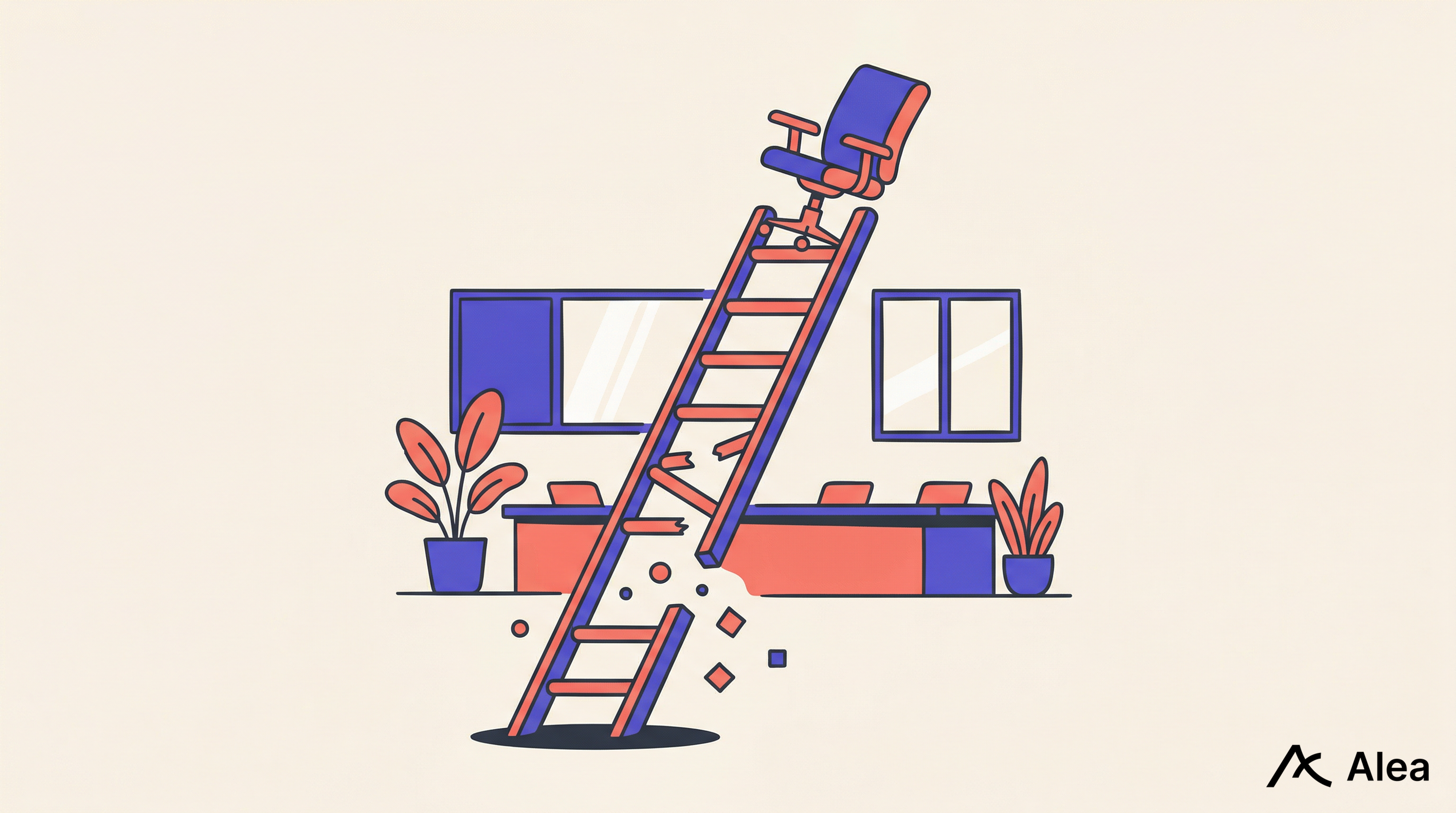
Many jobs are still useful. Perhaps less necessary. After the latest releases of frontier models the labor market did not break with a bang. Not yet at least. It is getting harder to enter though. Also harder to climb. Overall harder to trust.
That’s what this moment feels like. Not mass unemployment. Something quieter and, in some ways, meaner. What if the real danger isn’t that work disappears, but that it stays, only in weaker form?
The title remains. The inbox remains. The job exists. Yet the firm hires fewer juniors, promotions slow, teams stay understaffed, and more of the work becomes easy enough to benchmark, replicate, or squeeze. You can still do the job. You just no longer command the same terms, the same trust, or the same future.
The Thinning Ladder
By early 2026, after Christmas promos gifting extra usage in AI tokens, even the silly word SaaSpocalypse had stuck long enough to become mood.
Another memo about focus. Another founder saying he could now ship with 4 people where he once budgeted for an entire team of at least 10. Another graduate hearing that the analyst class would be “more selective this year.”
A model demo here, a hiring freeze there, and suddenly respectable white-collar work looked less secure, not because it had vanished, but because too much of it had become easier to imitate, check, compress, or postpone.
The room had bad coffee, soft chairs, and the defensive neutrality of hotel conference suites.
Elias Voss sat very still, as if the room were already wasting his time with euphemism. Max Vale looked relaxed, quick, faintly provocative, like a founder already bored by objections. Mara Flint sat motionless, alert, and unseduced, like a critic who’d spent too long listening to elites rename pain as progress. Daniel Reed had a legal pad, neat handwriting, and the air of someone who translated grand claims into hiring plans and margin math. Julian March looked like the last defender of craft, dignity, and the old idea that being needed should mean something more than being efficient.
Daniel spoke first.
“Let’s get precise. A job is a bundle of tasks, judgment, coordination, and liability. Firms do not buy the bundle for moral reasons. They buy it because someone has to produce the work and someone has to own the mistake. AI doesn’t have to remove the whole bundle to change the staffing math.”
Max smiled. “That’s the CFO version.”
“It’s the firm version,” Daniel said. “There are 3 margins to watch. Seat count, wages, and promotion velocity. People fixate on seat count because it’s visible. The other 2 may matter more.”
He glanced at the pad, then ignored it.
“Take a finance team. You still need a controller. You still need someone who’ll answer the board when the forecast is wrong. But maybe you no longer need 6 junior analysts cleaning data from 9 systems, rebuilding the same deck 4 times, and fixing links at midnight. Maybe you need 2 strong analysts, 1 systems person, and a manager with a wider span. Same function. Fewer first rungs.”
Julian leaned forward. “And the lost rung is not a rounding error to the person standing below it.”
Max said, “Let’s not canonize grunt work. A 23-year-old aligning logos at 1 a.m. is not civilization. If the sludge disappears, good.”
Julian turned to him. “No one is canonizing it. I’m saying the drudgery often concealed the lesson.”
“That’s a graceful sentence,” Max said. “It’s still drudgery.”
“Sometimes,” Julian said. “Sometimes not. A junior architect learns by redlines. A paralegal learns by assembling the first ugly draft and seeing where it breaks. A young agency copywriter learns by watching a creative director cut 11 adjectives and keep 1 verb. Those tasks are not noble because they are tedious. They matter because they place a young person inside a chain of judgment.”
Daniel nodded. “That’s the training subsidy. Low-value work used to help pay for apprenticeship. Once the low-value work gets automated, firms often stop pretending they’re in the education business.”
He looked up.
“An audit associate who once learned by building the workpaper now gets a half-filled file and is judged on whether he spots a bad assumption he never had to construct. A junior recruiter no longer reads 300 messy resumes and slowly learns a market. She reviews 40 ranked profiles and inherits the filter’s blind spots. The task survives in altered form. The learning curve changes.”
Mara Flint said, “And the young feel that before the economists do.”
No one interrupted, so she kept going.
“The 26-year-old law graduate hears the firm still has plenty of work. Fine. What it no longer has is 40 places where people like her used to enter. The recruiter isn’t lying when he says the profession is healthy. He’s lying by omission. Healthy for whom. Healthy at what level. Healthy after how many years of hanging around the edge of it.”
Max opened his hands. “Demand expands too. Cheaper legal research means more people can afford legal help. Cheaper design means more design gets bought. Cheaper software means more software gets written. You’re freezing the economy in the exact shape it had before the tools arrived.”
Mara didn’t blink. “I’m freezing the landlord.”
That got a short laugh, even from Daniel.
She went on. “You can tell a 24-year-old account manager that new forms of value will emerge. Her lender still wants the payment on the 1st. Her parents still ask whether the move to the city was worth it. Her friends still post the rare wins. She lives in the gap between your future demand curve and this month’s invoice.”
Daniel said, “Max is right about expansion in general. The mistake is assuming expansion rebuilds the same ladders. A small business may now buy legal help it couldn’t afford before. Good. That doesn’t mean the large firms restore the junior intake they just cut.”
Max leaned forward. “Come on. Why would they restore the old intake if the old intake was partly busywork? A 5-person product team can now test 12 ideas instead of 3. A one-person recruiter can source, screen, and schedule at a volume that used to require 3 coordinators. A founder can build internal tools in a weekend instead of filing a budget request and waiting a quarter. That is real. You can sneer at founder math. It still changes what gets built.”
“Of course it does,” Daniel said. “I’m saying the seat map changes first.”
Julian lifted a finger. “And the social map changes with it. A profession is not just tasks plus pay. It is a way a society tells people: stand here, learn this, do it well, and you may belong.”
“Some professions are tollbooths with blazers,” Max said.
Julian gave him a thin smile. “Yes. I concede that happily. A lot of white-collar life has been decorative suffering. Some of it deserved to die. But it is a mistake to think you can remove the old initiation without replacing the initiation.”
Daniel looked at Max. “Another concrete version. A bank used to hire 60 junior analysts across a region. Now maybe it hires 25. Not because capital markets vanished. Because first-pass models, summaries, and comparable sets get built faster, and the senior people trust the tooling enough to run leaner. The 25 inside may progress faster. The missing 35 do not become an abstraction. They scatter into worse matches.”
Max said, “Or they start companies.”
Mara snorted. “There it is.”
“What?”
“The religion of men who never have to say the sentence out loud to their own children.”
Max’s face tightened. “That’s cheap.”
“It’s concrete,” Mara said. “Most people do not want to become founders because a platform company improved autocomplete. Most people want a legible adulthood. They want a place to enter, a boss who notices if they get better, a salary they can plan around, and some reason to believe the next 5 years cash out into more than better prompting.”
Daniel murmured, “The last phrase is stronger than the data.”
“Your problem, Daniel,” Mara said, “is that you keep speaking in percentages when the injury arrives as biography.”
He took that without protest. “Fair.”
She pressed.
“A society can absorb hardship. It struggles with humiliation. There is a difference between ‘my sector had a bad year’ and ‘I spent 6 years climbing toward a floor that has been quietly removed.’ The second one breeds a very particular bitterness. Overeducated, underused, half-ashamed, and told to call it agility.”
Julian said, softly, “Useful and surplus at the same time.”
“Yes,” Mara said. “That is poison.”
Max looked at her for a long moment. “You reach for social fracture too fast.”
“I’m not talking about barricades,” Mara said. “I’m talking about group chats. I’m talking about the 29-year-old who moved home and tells everyone it’s temporary. I’m talking about the associate who is technically employed but knows the firm no longer needs many people like him, only a few unusually polished ones. I’m talking about the HR coordinator whose new tool drafts 70 percent of her outbound messages, so she keeps the job and loses the only leverage she had, which was being hard to replace under deadline.”
Daniel stepped in. “Many workers won’t be replaced outright. They’ll be degraded in bargaining power. That’s a different problem and, in some ways, a nastier one.”
Max tilted his head. “Nastier than unemployment?”
“In a particular way, yes,” Daniel said. “Because it hides. The recruiter still works. The compliance analyst still works. The sales ops person still works. But the employer knows more of their output can be standardized, checked, or reproduced. So raises get tighter. Teams run with more vacancies. Promotions slow. One person covers 2 territories with a tool and a longer evening.”
Julian said, “You remain needed enough to be used, not needed enough to bargain.”
“Exactly,” Daniel said. “A support team might keep most of its people because customers still escalate and someone has to own the relationship when things get strange. But if one manager can now supervise 18 AI-assisted reps instead of 9 ordinary ones, the organization doesn’t feel automated from the outside. It still hired less. It still flattened the ladder.”
Max said, “Or it served more customers with the same payroll.”
Daniel gave him an almost apologetic look. “That can happen too. Distribution is the question.”
Max sat back. “Good. Then let’s talk about distribution honestly. The upside is not ornamental. Cheap intelligence is a cost collapse in expertise. When that happens, whole categories come into reach. A small manufacturer can get planning help it used to reserve for consultants. A family with a complicated tax question can get a decent first answer without paying $400 an hour. A nurse practitioner in a thinly staffed clinic can offload paperwork that used to eat the evening. A nonprofit can draft a grant application that no one on staff had the time to write properly. A 2-person exporter can finally handle customs paperwork, support emails, and forecasting without hiring 3 specialists. You can call that impersonal. It still matters.”
Julian nodded first. “It does.”
Mara followed, reluctantly. “Yes. Cheaper competence is a real public good.”
Daniel said, “Agreed. Access improves. Some incumbents were rent collectors. That part of the optimistic case is solid.”
Max spread his hands as if to say exactly.
Then Daniel kept going. “But access gains do not automatically settle labor losses. A cheaper tax answer helps the family buying it. It does not tell the junior accountant what his ladder becomes. Those are different questions.”
Max exhaled through his nose. “Fine. A cap table is not a social contract.”
“Relieved to hear it,” Mara said.
He ignored her. “What I resist is the sentimentalism. Some people in this debate talk as if the purpose of technology is to preserve the 2019 org chart. It isn’t. If the tools make people more capable, more markets become worth serving, more tiny firms become viable, and more weird ideas get built. That matters too.”
Julian said, “Yes. It matters. It simply doesn’t answer the status question.”
“Status can move,” Max said.
“Can it move fast enough?” Julian asked. “Can it move in a way the median person can inhabit? That is harder.”
He turned the stem of his glass between his fingers.
“You can tell an intelligent young person, truthfully, that the world now offers cheaper expertise, more tools, more possibility. Then he looks around and notices that the old middle path, the one with supervisors, standards, and incremental trust, is narrowing in real time. He does not live inside aggregate possibility. He lives inside the entry.”
Elias Voss, who had been visibly impatient for the last 20 minutes, finally cut across the table.
“You are still debating staffing geometry.”
Max smiled. “Welcome.”
Elias ignored him. “The larger issue is control. If you build systems that can research, plan, persuade, code, negotiate, and operate other systems, the labor question becomes a local symptom. You are arguing about seat counts inside institutions that may not remain governable.”
Mara said, “Ordinary people do not mobilize around that sentence.”
“Lack of salience is not a safety property,” Elias said.
Daniel leaned in. “It does make the issue politically secondary until nearer harms appear.”
“No,” Elias said. “It makes it easier to ignore.”
Max said, “You do this every time. People ask what happens to work, and you answer with metaphysics.”
“No,” Elias said. “With power.”
He looked around the table.
“An insurer uses a model to triage claims. A bank uses agents to write internal analyses no senior person fully reads. A procurement office lets systems negotiate low-value contracts at scale. A media company floods the zone with acceptable copy overseen by one exhausted editor. These are not metaphysical examples. They are institutions handing judgment to processes they cannot fully audit.”
Daniel said, “Firms already hand judgment to opaque processes all the time.”
“Yes,” Elias said. “Badly. Now scale it.”
Julian spoke before Max could.
“What matters for labor is not only replacement. It is answerability. A difficult superior can at least be faced. A process no one will stand behind produces a different kind of humiliation.”
Mara nodded. “And a different kind of anger. When the claim is denied, the bonus disappears, the performance review drops, and no one can explain the chain except to say ‘the system flagged it.’”
Daniel said, “That’s where your argument meets mine. Even short of extreme capability, organizations can get much more opaque while insisting humans remain in the loop. In practice that often means one senior person nominally responsible for work generated or filtered upstream by systems they did not design.”
He looked at Max.
“A publishing firm doesn’t fire every editor. It keeps a few and asks them to supervise 200 machine-assisted pieces a week. A hospital billing team doesn’t disappear. One supervisor now signs off on exception queues that arrive pre-sorted by models. A regional sales manager still needs reps. But she now manages 14 territories with 9 people, because the system drafts follow-ups, scores leads, and tells the company that coverage is ‘sufficient.’ A junior policy researcher edits a synthetic brief instead of writing the first memo, which means she learns style but less of search. None of that looks like a robot apocalypse. It still changes how work feels.”
Elias gave Daniel a brief nod. “Closer.”
Mara looked at Elias. “Your blind spot is still the same. People will not march against the phrase ‘capability overhang.’ They will march against not getting hired, against opaque downgrading, against being told by a cheerful executive that automation lets them ‘focus on higher-value work’ right before the team loses 30 percent of its seats.”
Elias was silent for a moment. Then he said, “Yes. Most societies react to pain before they react to abstraction. I grant that. But pain arrives inside systems. If those systems are becoming more capable and less legible at the same time, the labor shock gets harder to contest.”
Max said, “Now that is at least a human sentence.”
Elias didn’t take the bait. “People will not say, ‘I fear misalignment.’ They will say, ‘No one can tell me why I was cut, why I can’t appeal, why the machine gets to draft and I get to carry blame.’ Those are labor questions. They are also governance questions.”
Mara gave him the smallest nod she had offered anyone all evening. “Fair.”
The room had warmed a little, or perhaps everyone had simply run low on posturing.
Daniel said, “We may be stacking too much on one variable. The next few years probably won’t deliver one clear outcome. In some sectors, seat counts fall. In others, employment holds but wages soften. In others, output expands and firms still hire, just less junior and more oddly. A lot depends on error tolerance, regulation, customer trust, and whether humans are needed mainly for judgment or mainly for cover.”
Max said, “There’s the economist’s hymn to heterogeneity.”
“It happens to be true,” Daniel said.
“It is true,” Mara said. “It also lets people hide.”
Daniel didn’t object. “Sometimes. But precision matters. A labor market can rot before it breaks. That rot won’t look the same everywhere.”
Julian looked at him. “Give me your bleakest ordinary example. Not the dramatic one. The common one.”
Daniel thought for a second.
“The common one is a 27-year-old marketing analyst who stays employed and still loses ground. The dashboard writes the first commentary. The meeting summary drafts itself. The A/B report half-populates. She does more in a day and learns less of the underlying craft. Over 3 years her salary barely moves, her manager now oversees 2 teams, and the next promotion has turned into one slot instead of four. No headline. No catastrophe. Just a weaker adult life.”
Julian closed his eyes for a beat. “Yes. That sounds right.”
Max said, quieter than before, “Then my ordinary positive example is also ordinary. A 2-person shop can finally do back-office work it used to outsource badly. A public defender can search faster. A school counselor can draft better plans for students. A small exporter can finally manage forecasting, compliance, and customer support without hiring 5 specialists. Those gains are not fake because the transition hurts.”
“They’re not fake,” Mara said. “They just don’t tell the whole story.”
“No,” Max said. “They don’t.”
Julian looked at him. “There is your concession.”
Max smiled without much warmth. “You all wanted one. Fine. Here it is. Abundance is not self-executing. Cheaper intelligence can widen access and still leave a lot of people feeling demoted. Founder delight is not a labor policy.”
“Good,” Mara said.
Then Julian turned his own knife inward.
“And here is mine. I do romanticize apprenticeship sometimes. Not every lost junior task was a sacred rite. Some of it was sheer waste performed for prestige. I know that. My concern is narrower. A society needs visible ways for young people to become trusted. If old firms stop offering them, new institutions must. I do not see those institutions yet.”
Daniel tapped the table once. “That’s the part I worry we’re underestimating. The replacement roles people gesture at, model auditor, workflow designer, domain reviewer, AI implementation lead, often require experience. They are not natural landing spots for the 22-year-old graduate whose old landing spot just shrank.”
Max said, “Some are. Not enough, probably. I’ll give you that.”
Mara looked at Daniel. “Your concession.”
He smiled. “I already gave one.”
“Give it properly.”
He did.
“A 10 percent drop in entry-level openings can produce more than a 10 percent rise in anxiety if it lands on elite credentials, delayed adulthood, and the suspicion that effort no longer purchases security. People do not live inside labor charts. They live inside stories about whether they did what was asked of them and whether the bargain held.”
Mara sat back. “There.”
Elias said, almost dryly, “My turn, I suppose.”
No one objected.
“I underweight short-term labor politics because I think the larger control problem is still more dangerous. That may be a tactical mistake. Most citizens will not act on the strongest reasons for concern. They will act on visible degradation first. If you want to understand the next phase, watch where labor opacity and capability growth touch. Watch the workplace where one human signs what 20 systems prepared. Watch the office where no one can explain who made the decision. Watch the profession that still exists but no longer trains.”
Julian said, “That last one may be the quietest disaster in the room.”
No one rushed to improve the line.
Outside the door, hotel staff had started clearing glasses from the reception down the hall. Somewhere below, a ballroom microphone fed back and cut out.
Mara broke the silence.
“Television keeps giving people 2 bad pictures. In one, robots take every job. In the other, nothing to worry about, new categories will absorb the slack. The common case is uglier. Plenty of people keep working. Plenty of services get cheaper. The macro chart may look fine. Meanwhile whole tranches of educated people feel themselves slipping from necessary to contingent. That is a combustible sentence even if the top-line numbers behave.”
Daniel said, “Yes. And adaptation may still be stronger than you think. Institutions do bend. New tasks appear. Some sectors surprise on the upside.”
She nodded. “I know. I understate that. Not every status insult becomes a riot. Most become private misery, postponed marriages, small humiliations, people lowering the altitude of their hopes. That’s still a political fact.”
Max said, “And I may understate how bad that feels from the inside.”
Julian looked at him. “From the inside is the only place it is ever felt.”
Elias stood first. “The worst mistake now would be premature clarity.”
Max laughed softly. “At last, something we can all invest in.”
But Elias kept going.
“People want one sentence. ‘AI will take all the jobs.’ Or: ‘AI will make everyone richer.’ They want a clean morality tale. I don’t think they get one. I think they get a period in which capabilities improve unevenly, firms reorganize opportunistically, workers feel the downgrade before the official categories catch up, and public language lags reality by several years.”
Daniel rose too. “That sounds right.”
Julian said, “And the hard question underneath it remains old-fashioned. Not whether a person can still produce value. Whether anyone is waiting to make a place for that value, teach it, recognize it, and pay it in a form that can sustain a life.”
No one improved on that either.
They drifted toward the door without agreement.
In the lobby, 2 students in conference lanyards were arguing over whether to keep chasing analyst roles or switch into implementation work before the market did it for them. At the front desk, a clerk was fixing a booking error the self-check-in screen had produced and nobody else could explain. The clerk still had authority because someone had to own the mistake.
The question was how many jobs would still include that kind of necessity, and how many young people would still be taught into it.
The biggest risk may not be that millions become useless. It may be that millions remain useful and still cease to feel necessary. That is the kind of change a society can misread for years because the salaries are still being paid, the offices still open, and the graphs still point up. But a social order built on work does not only need output. It needs places where people can enter, become legible, earn trust, and matter in a way no one has to squint to see. If AI helps us produce more while quietly shrinking those places, the loss will arrive long before we find the courage to name it.